
Teatro Romano
- Piazza Caduti nei Lager Nazisti
Il Teatro Romano di Volterra fu riportato alla luce negli anni Cinquanta grazie agli scavi archeologici condotti a Vallebuona dallo storico volterrano Enrico Fiumi. È interessante notare che, come ricordato da una targa all’ingresso, alcuni degli operai impiegati negli scavi erano ricoverati presso l’Ospedale Psichiatrico di Volterra.
Datato alla fine del I secolo a.C., fu finanziato dalla ricca famiglia volterrana dei Caecina, come attestato da un’epigrafe conservata nel Museo Etrusco Guarnacci. Costruito sfruttando il pendio naturale, un’area già terrazzata, il teatro presentava sedili in calcare locale con incisi i nomi di influenti famiglie romane e scalinate in pietra di Montecatini Val di Cecina.
La frontescena si estendeva per quasi 36 metri con due piani colonnati alti oltre 16 metri, e il teatro poteva ospitare circa 3500 spettatori. Un “velarium” forniva ombra, come testimoniano le tracce della struttura di supporto. Abbandonato alla fine del III secolo, il sito ospitò un impianto termale e, in epoca medievale, le mura cittadine inglobarono parte delle gradinate.
Oggi i resti sono visitabili nell’area archeologica, con accesso da Porta Fiorentina. Occasionalmente, d’estate, il teatro ospita rappresentazioni e l’annuale Festival Internazionale, dove vengono assegnati i premi “Ombra della Sera” a personalità di spicco del mondo dello spettacolo e della cultura.
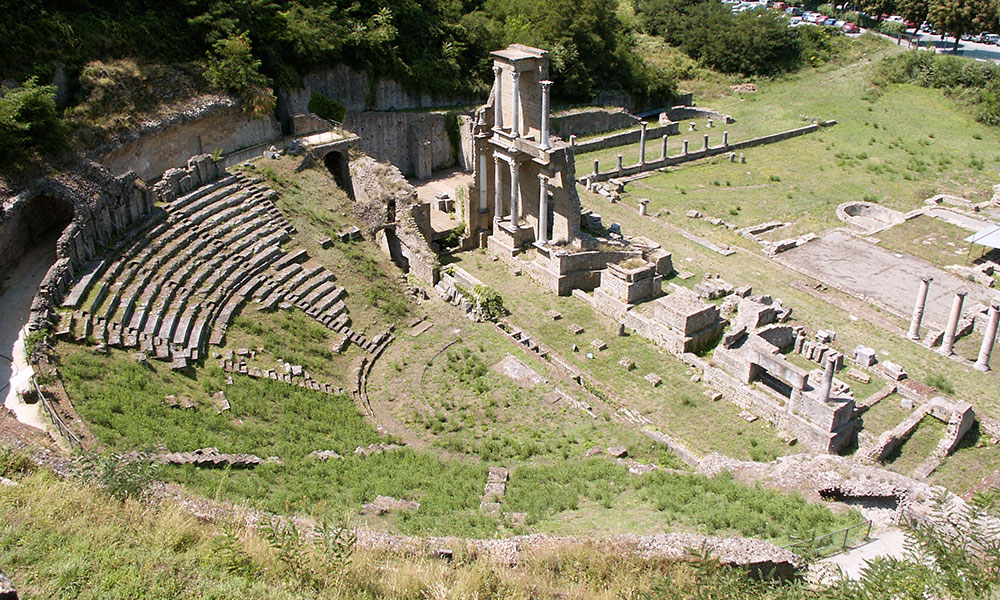
The Roman Theater of Volterra was brought to light in the 1950s thanks to archaeological excavations conducted in Vallebuona by Volterra historian Enrico Fiumi. Interestingly, as a plaque at the entrance commemorates, some of the workers employed in the excavations were patients at the Volterra Psychiatric Hospital.
Dating to the late 1st century BC, it was financed by the wealthy Caecina family of Volterra, as attested by an epigraph preserved in the Guarnacci Etruscan Museum. Built on the natural slope, an area already terraced, the theater featured seats made of local limestone inscribed with the names of influential Roman families and steps made of Montecatini Val di Cecina stone.
The front stage extended almost 36 meters with two colonnaded tiers over 16 meters high, and the theater could accommodate approximately 3,500 spectators. A “velarium” provided shade, as evidenced by traces of the supporting structure. Abandoned at the end of the 3rd century, the site housed a bathhouse, and in the Middle Ages, the city walls incorporated part of the steps.
Today, the remains can be visited in the archaeological area, accessed from Porta Fiorentina. Occasionally, during the summer, the theater hosts performances and the annual International Festival, where the “Ombra della Sera” awards are presented to prominent figures from the world of entertainment and culture.